 Cape Coral Solar Service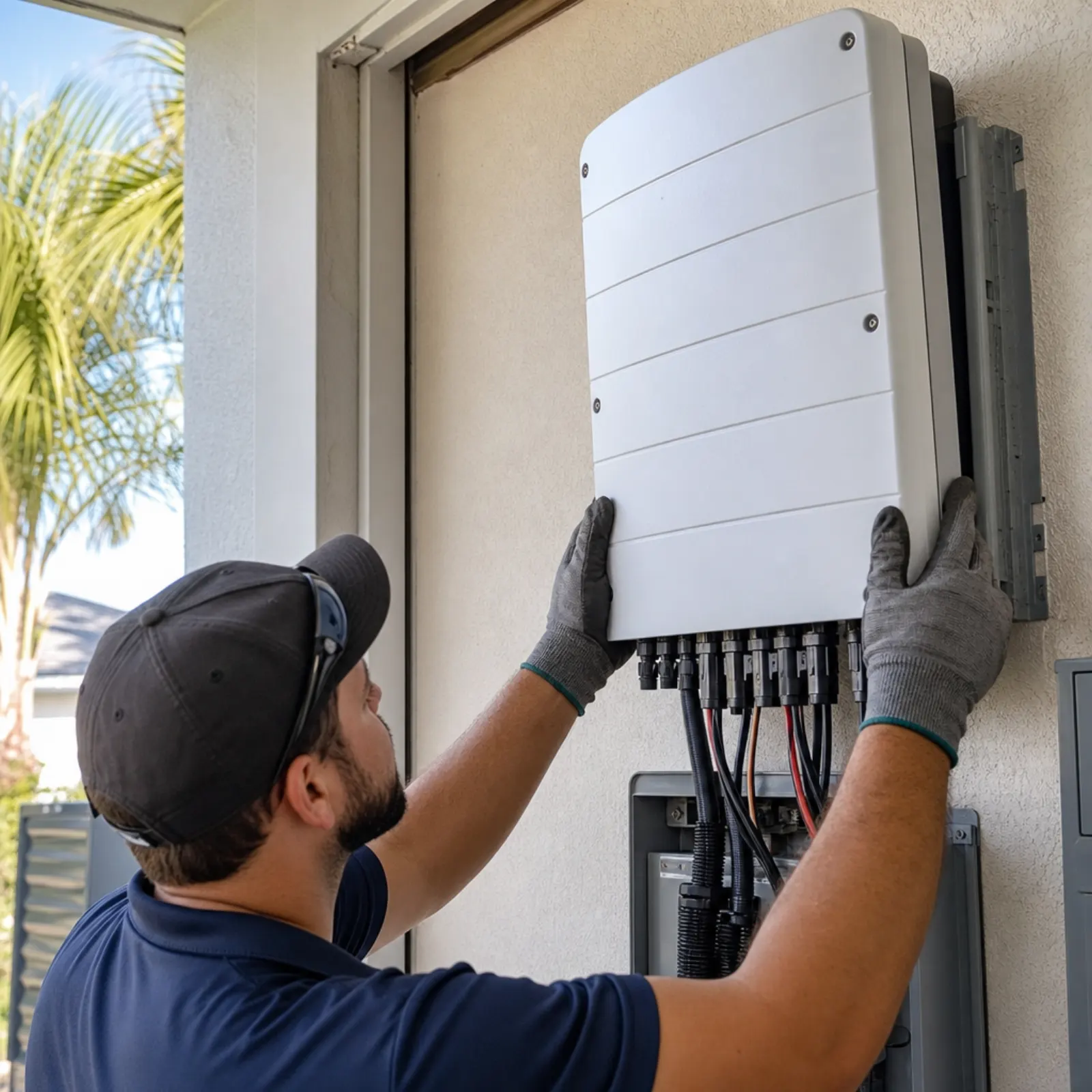
Cape Coral Solar Service works on rooftop solar systems that are already on the roof: panels detached and reset when the roof is replaced, dead string inverters and failed microinverters swapped, storm-damaged panels replaced, and systems whose installer disappeared brought back online. Detach and reset runs $200 to $400 per panel, a string inverter replacement $1,500 to $3,500 installed, a microinverter or optimizer swap $300 to $600 each, and a diagnostic visit $150 to $350. Send a photo of the array, the inverter label, and your monitoring screen, and you get a real number without a sales visit.
This is not a solar sales site. Nobody here will pitch you a new system, a lease, or a savings projection. The work is keeping the system you already paid for producing, permitted, and interconnected, across Cape Coral, Fort Myers, North Fort Myers, Lehigh Acres, Bonita Springs, Estero, and Punta Gorda.
The three jobs that bring Lee County homeowners here
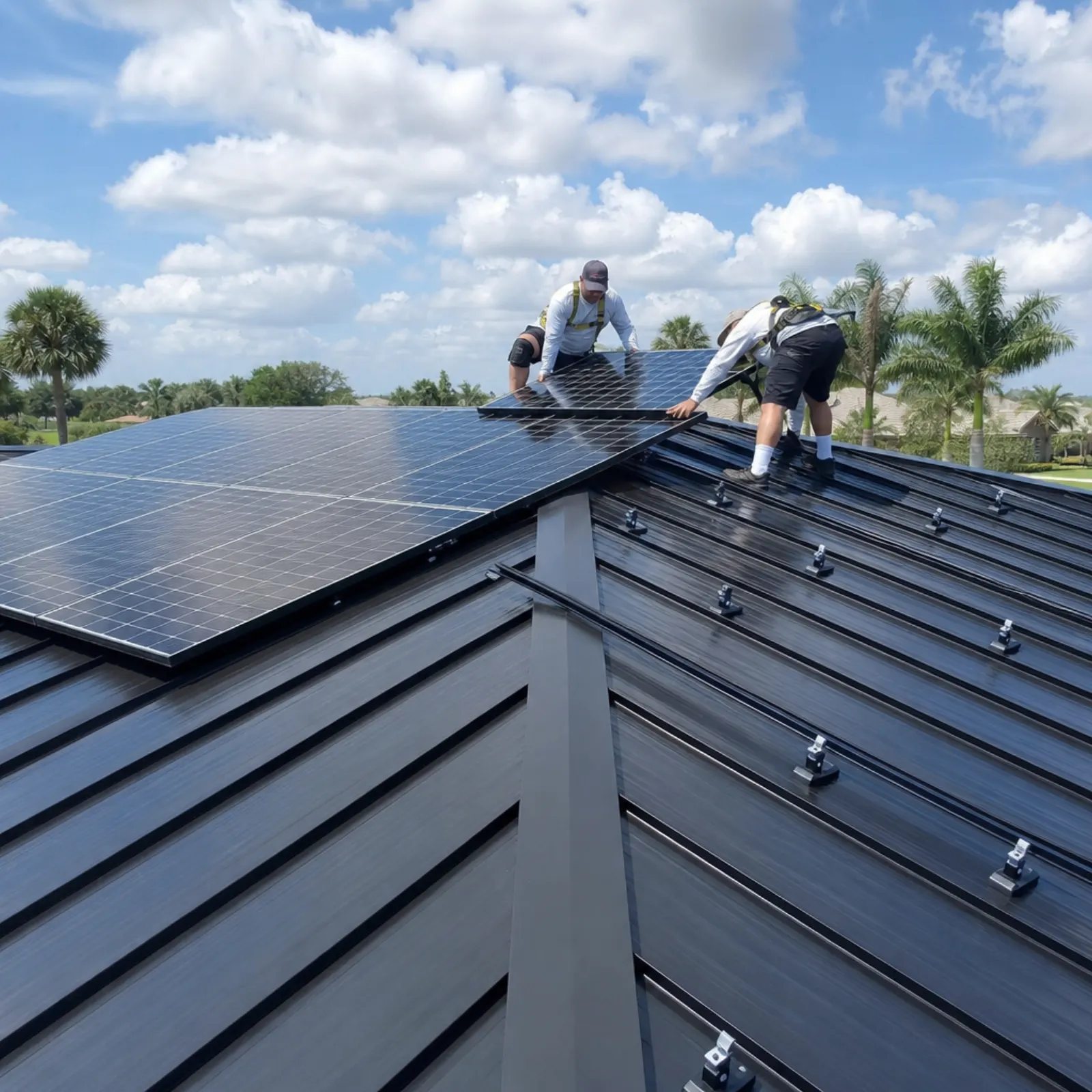
The roof is being replaced and the panels are in the way. Southwest Florida is re-roofing at a pace no other market matches. The National Hurricane Center’s report on Hurricane Ian counts 52,514 structures impacted in Lee County alone, 5,369 of them destroyed and 14,245 with major damage, after the storm came ashore at Cayo Costa on September 28, 2022 with 130-knot winds. Two years later, on October 9, 2024, Hurricane Milton’s rainbands dropped an EF2 tornado with 132 mph winds on a 16.56-mile track from south of Gladiolus Drive in Fort Myers, across the Caloosahatchee, and through North Fort Myers manufactured-home communities before lifting near US 41, according to the National Weather Service Tampa Bay damage survey. Layer on Florida’s insurance rules, which since the May 2022 special session let an insurer require replacement of a roof 15 years or older unless an inspection certifies at least five years of useful life (Florida Statute 627.7011(5)), and you have a county full of tile and shingle roofs coming off with solar arrays bolted to them. The roofer will not touch the panels. The original installer is often gone. That gap is the panel removal and reinstall service.
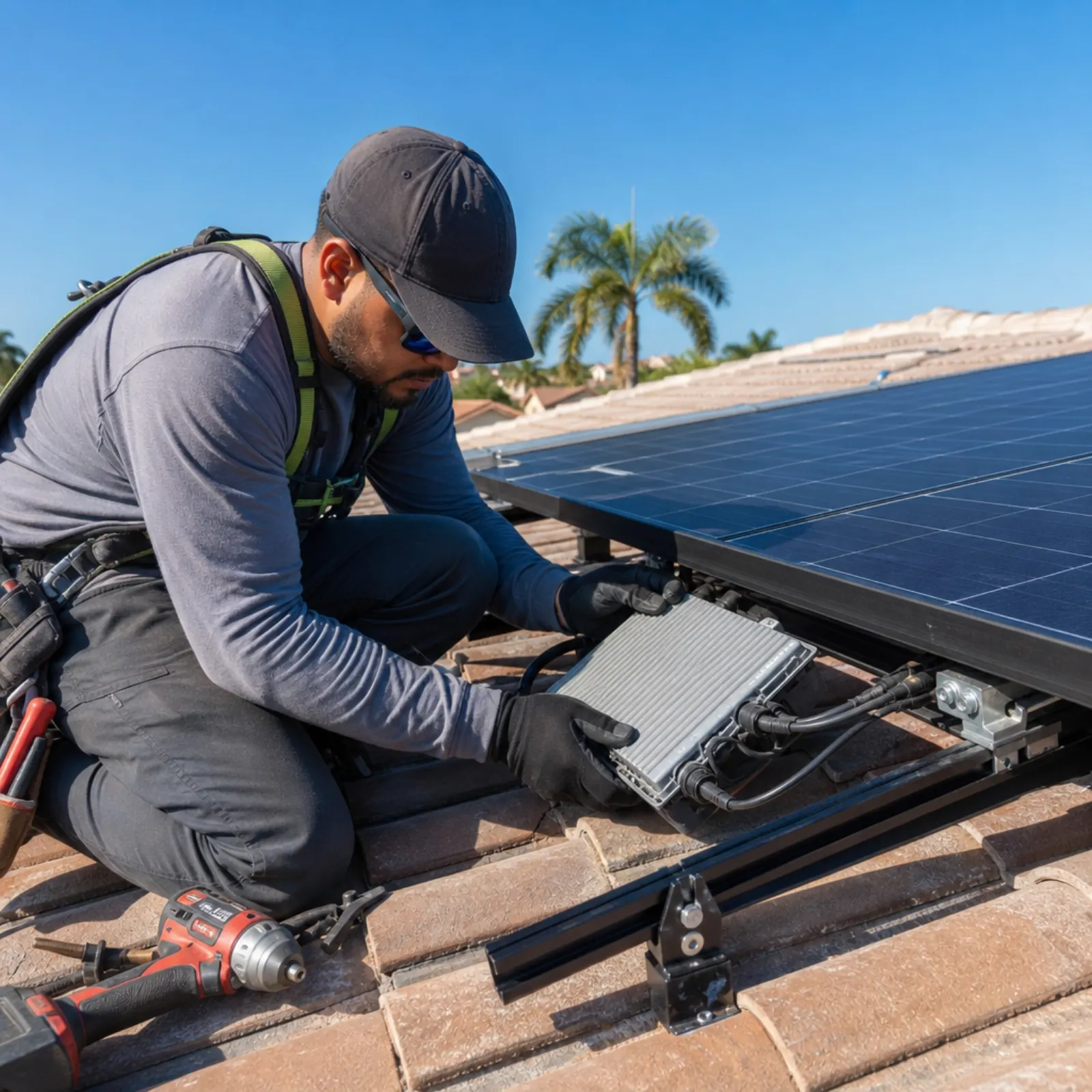
The inverter died. String inverters from SMA, SolarEdge, Fronius, and ABB or FIMER last 10 to 15 years, and the first big wave of Lee County residential solar is now hitting that age. Enphase M215 and M250 microinverters and SolarEdge optimizers fail one at a time, and the symptom is one panel dark in the app while the neighbors produce. A proper repair starts from your monitoring data, replaces like-for-like or retrofits a modern unit, gets it permitted, updates the utility interconnection, and restores monitoring. If you are not sure yet what your system is doing, the symptom pages start from what you can see: a red light, one panel dark in the app, production that dropped, a breaker that keeps tripping. See inverter replacement.
The installer is gone. SunPower filed Chapter 11 in the District of Delaware in August 2024 and sold its Blue Raven, New Homes, and dealer-network assets to Complete Solaria for $45 million, and the successor company has said it is not responsible for systems installed on or before September 30, 2024. Titan Solar Power, which installed in more than 20 states, closed on June 13, 2024 and filed Chapter 7 in Arizona about a week later. Pink Energy, formerly Power Home Solar, filed Chapter 7 in the Western District of North Carolina on October 7, 2022 with an estimated 25,000 to 50,000 creditors. Vision Solar filed Chapter 7 on December 28, 2023 while facing a Florida Attorney General lawsuit that alleged it failed to complete permit requirements on customer systems, leaving owners with fines and liens. ADT announced on January 24, 2024 that it was exiting residential solar entirely. Every one of those left Florida rooftops with nobody to call. The orphaned system service exists for exactly that phone call.
What gets serviced
- Panel removal and reinstall for re-roofs: detach 1 to 3 days before tear-off, label every string, store on site, reset on new flashed attachments, re-commission, close the permit.
- Inverter replacement: string inverters, Enphase microinverters, SolarEdge optimizers, including brands whose maker is gone.
- Solar panel repair and replacement: cracked, delaminated, hail- or debris-struck panels; MC4 connector corrosion; rodent-chewed wiring; conduit and junction box repair.
- Orphaned system service: takeover diagnostics, monitoring restored, manufacturer warranty claims filed, repairs on any brand.
- Cleaning and inspection: production check against expected output, visual and thermal inspection, salt and pollen cleaning.
- Battery and monitoring repair: Tesla Powerwall, Enphase IQ, LG, and Generac PWRcell diagnostics; Envoy, SolarEdge, and Tesla gateways that stopped reporting.
Why Cape Coral solar is a service business, not a sales business
The roof stock. Cape Coral was platted in 1957 by Leonard and Jack Rosen and incorporated on August 18, 1970, and it has more than 400 miles of canals, more than any city in the world. The southeast Cape carries the original 1960s and 1970s concrete-block bungalows and 1980s and 1990s tract homes; the southwest mixes older canal-front block homes with new luxury construction; the northeast and northwest are where most new building has happened, on freshwater canals. Almost everything is concrete block with a tile, shingle, or metal roof, and a large share of that roofing has been replaced or is about to be. Every re-roof on a house with solar is a detach-and-reset job, and a tile roof is a different job from a shingle roof.
The storms. Ian put 6 to 9 feet of surge inundation into Pine Island, Cape Coral, and the communities at the mouth of the Caloosahatchee, and the USGS sensors in Matlacha and Cape Coral were destroyed by it, per the NHC report. Ian’s total damage in Florida was $109.5 billion, the costliest hurricane in the state’s history. The southeast Cape, built largely before 1993, sat in standing water for days. Wind lifted panels, debris cracked glass, and salt water found every connector it could reach. Milton in 2024 knocked out power to 129,000 LCEC and 111,000 FPL customers in Lee County at the county’s October 10 briefing. Arrays that survived both storms are often producing less than their owners think, which is why an inspection with a production report is the sensible first step on any system older than five years.
Two utilities, two rulebooks. Cape Coral, North Fort Myers, Pine Island, Sanibel, Captiva, and Lehigh Acres are LCEC territory; LCEC has been a cooperative since 1940, when North Fort Myers grove owner George Judd sold the Mariana Grove power plant to its members, and it serves more than 250,000 customers today. Fort Myers, Bonita Springs, Estero, and Punta Gorda are FPL. Both utilities run net metering under Florida Public Service Commission Rule 25-6.065, both require the local building official’s inspection certificate before a system goes into service, and both tie your credit to an interconnection agreement that names the inverter. When the inverter changes, the paperwork changes. The contractor doing the swap files it.
Two permitting authorities in Cape Coral alone. Inside city limits, permits go through the City of Cape Coral Building Division at City Hall, 1015 Cultural Park Boulevard, via the EnerGov Citizen Self Service portal. Unincorporated Lee County goes through Building and Permitting Services at 1500 Monroe Street in Fort Myers, via eConnect, which contractors are required to use. Lee County’s guide requires signed and sealed wind-load documentation showing the uplift zone and pressure for the roof area where the panels sit, under the Florida Building Code 8th Edition (2023) and the 2020 NEC, and it closes a roof-mounted system with a 207 Solar Final and a 305 Electrical Final. A crew that tells you a re-roof reset does not need a permit is telling you something about how they work.
How a detach and reset actually goes
- Plan review. Panel count, racking brand (IronRidge, Unirac, SnapNrack), attachment type, inverter type, monitoring access. Tile, shingle, or metal.
- Coordinate with the roofer. Detach 1 to 3 days before tear-off. Strings labeled, panels stacked on site, conduit capped, rapid shutdown and disconnects locked out.
- After the new roof. New flashed attachments, set by the roofer or the solar crew per a written agreement, then rails, panels, wiring, rapid shutdown, labeling.
- Re-commission. Inverter startup, per-panel monitoring verified, utility notified if the interconnection changed, permit closed with the final inspection.
The full sequence, what to put in the roofer’s contract, and the tile-versus-shingle differences are on the detach and reset page.
Honest pricing, published
| Job | Typical range |
|---|---|
| Diagnostic or service visit | $150 to $350 |
| Detach and reset for re-roof | $200 to $400 per panel |
| New flashed roof attachments | $25 to $60 each |
| String inverter replacement (5 to 10 kW) | $1,500 to $3,500 installed |
| Microinverter or optimizer replacement | $300 to $600 each |
| Panel replacement | $400 to $900 per panel |
| Wiring, connector, conduit repair | $250 to $900 |
| Monitoring gateway replacement | $300 to $800 |
| Cleaning | $10 to $20 per panel, $150 to $250 minimum |
| Inspection with production report | $200 to $400 |
| Battery diagnostic | $250 to $500 |
Panel count, roof type, and whether a permit or an interconnection update is needed set the price. The pricing page explains what moves each number and what a whole job costs.
What is still under warranty when the installer is gone
Panel and inverter manufacturer warranties are tied to the equipment, not to the company that installed it, and most major manufacturers are still honoring them for orphaned systems. Enphase publishes a 25-year limited warranty on its IQ and M-series microinverters. SolarEdge covers optimizers for 25 years and inverters for 12. But read the fine print: Enphase’s current U.S. warranty excludes the cost of labor to uninstall or reinstall a covered product, requires claims within 90 days of discovering the defect, and ships the replacement to the original installation address. Someone still has to get on the roof, and that is the part the bankrupt installer used to do. Workmanship warranties, roof-leak warranties, and production guarantees from the installer are gone. The manufacturer claim still has to be filed and the part received, and we do the labor at the published rates.
Areas covered
The service covers the whole Cape, across the Cape Coral and Midpoint bridges to Fort Myers, up US 41 north to North Fort Myers, east to Lehigh Acres, south on I-75 to Estero and Bonita Springs, and north over the Peace River to Punta Gorda. Whether you need panels removed or someone to service the system, any address in that area is in the service area.
Send three photos: the array from the ground, the inverter label, and your monitoring screen. We look them over, and what you should get back is a first diagnosis, a number from the published ranges, and a realistic schedule. Questions first? Start with the FAQ or read how we work.