 Cape Coral Solar Service
 Solar Panel Repair and Replacement in Cape Coral
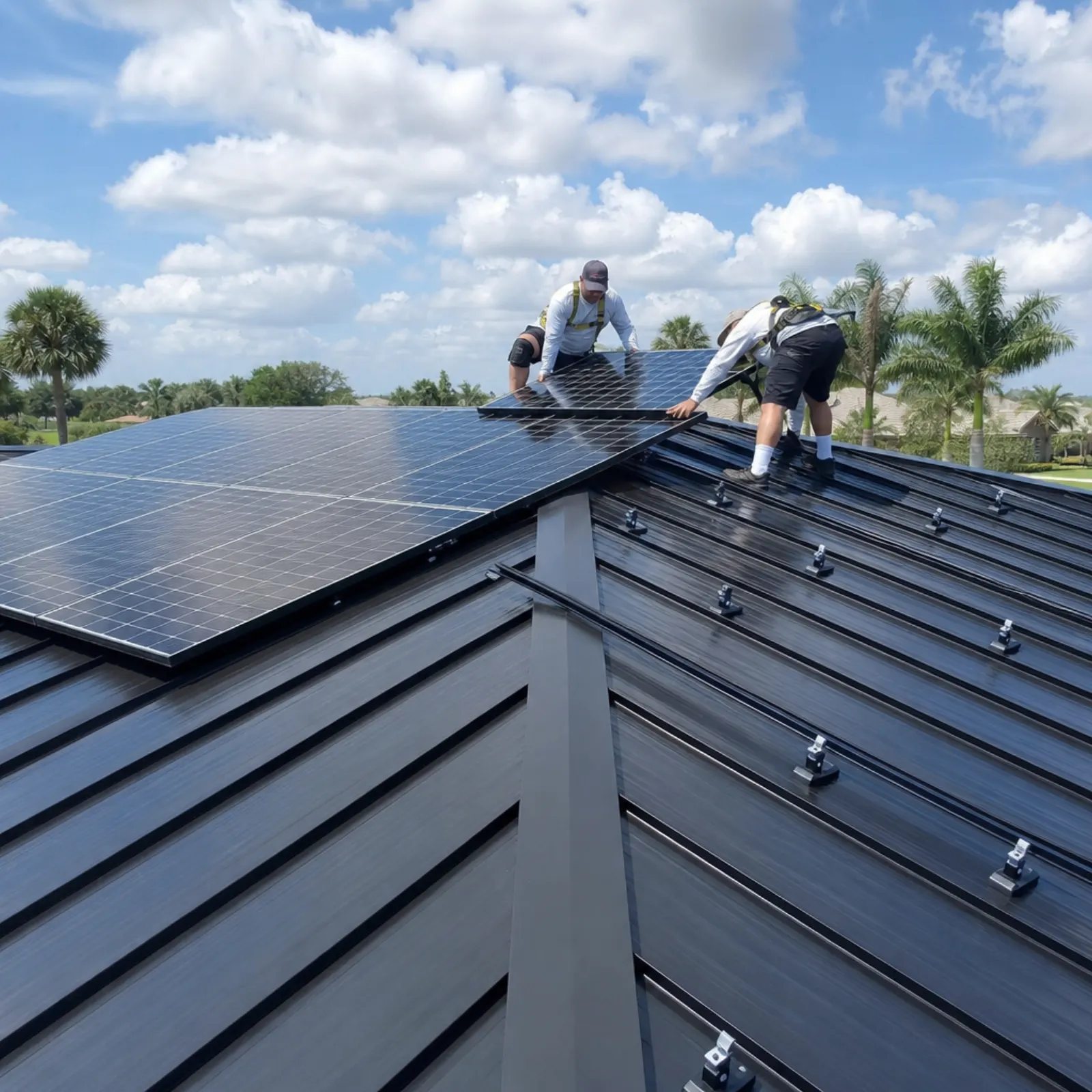
Solar panel replacement in Cape Coral runs $400 to $900 per panel installed, and repairs to the wiring, connectors, and conduit around the array run $250 to $900. Cracked glass, delamination, hot spots, and debris strikes mean a new module; corroded MC4 connectors, rodent-chewed cable, water in a junction box, and conduit that Ian pulled loose can be repaired. The hard part is never the labor. It is matching a panel that went out of production three years ago. Send a photo of the damage and the panel label; that is what we need to say what is possible.
What breaks panels in Lee County
Storms and debris. Hurricane Ian came ashore at Cayo Costa on September 28, 2022 with 130-knot winds by the National Hurricane Center’s measure, and its surge reached 6 to 9 feet above ground in Cape Coral and along the mouth of the Caloosahatchee. Roof tiles, tree limbs, pool cage panels, and neighbors’ debris became projectiles. Arrays that stayed on the roof took hits. Hurricane Milton’s rainbands on October 9, 2024 dropped an EF2 tornado across Fort Myers and North Fort Myers and an EF1 on Matlacha, per the National Weather Service Tampa Bay survey, and the debris field around a tornado track cracks glass a block away from the roof damage.
Salt. Canal-front homes in the southwest and southeast Cape, Punta Gorda Isles, and Bonita Beach sit in salt air. MC4 connectors that were not fully seated, or that were mated between two brands, corrode and heat up. Rail hardware pits. Grounding lugs go green. This is slow, and it shows up as a ground fault, an arc fault, or a string that reads low.
Rodents and birds. Palm rats and squirrels nest under arrays and chew cable insulation. Birds nest under panels on low-slope roofs. Both cause ground faults and both are fixed with wiring repair plus critter guard.
Heat and age. Delamination (the laminate separating from the glass, visible as bubbles or milky patches), snail trails, and browning junction boxes on panels from the 2010s. Some are warranty cases with the panel maker; most are replacements.
Installation defects from installers that are gone. Under-torqued rail clamps, cable runs left in sunlight, connectors pulled tight around a corner. When the installer has closed, these become your problem at the first storm, and they are exactly what an orphaned-system takeover catches.
Replace or repair: the triage
- Cracked glass, shattered glass, visible cell damage. Replace. Water reaches the cells within weeks in Florida humidity.
- Delamination, bubbling, milky laminate. Replace, and check the maker’s product warranty first; many panel makers warrant against delamination for 10 to 25 years.
- Hot spot on a thermal image with no visible damage. Usually a failed bypass diode or a cracked cell. Replace the panel; a hot spot is a fire risk in a dry October.
- Burnt or melted junction box. Replace the panel and inspect the neighbors; a burnt box usually means a connector fault upstream.
- Corroded or heat-discolored MC4 connectors. Repair. Cut back, new connector pair of a single brand, properly crimped and seated. Never mixed-brand mating.
- Chewed cable insulation. Repair with new cable or heat-shrink and a sleeve depending on extent, plus critter guard.
- Water in a rooftop junction box or combiner. Repair. Dry, replace the box or gasket, correct the conduit entry that let water in.
- Conduit pulled loose, broken straps, open fittings. Repair. Common after Ian on arrays where the conduit ran across the roof unsupported.
- Loose or lifted rail, missing clamps. Repair, and re-torque the whole array while the crew is up there.
The matching problem, honestly
Solar modules change every year: dimensions, cell count, voltage, current, connector type, frame thickness. A panel installed in 2017 is out of production, and the replacement has to fit the same rail spacing and clamp thickness and, more importantly, match the string electrically. In a string inverter system, one mismatched panel drags the whole string to its current. In a SolarEdge or Enphase system, each panel has its own electronics and a mismatch costs less, but the replacement still has to sit within the optimizer or microinverter’s input range.
Options in order of cost:
- Same model from stock. Occasionally a distributor or a closed installer’s inventory has your exact panel. Bottom of the range.
- Compatible module. Same frame size, close electrical specs, confirmed by a string review, sometimes with a different clamp. Most jobs.
- String rearrangement. Drop the odd panel, re-string the rest, fill the hole with a non-matching panel on its own microinverter. Requires a permit drawing update.
- Whole-face replacement. When a storm damaged three or more panels on one roof face, replacing the face with matched new modules is cleaner and is usually the insurance claim. The damage should be documented with serial numbers and a production comparison for the adjuster.
You should know which applies before any quote. A contractor who quotes a “matching panel” without asking for the label is guessing.
Permits
Lee County’s Solar-Photovoltaic permit guide requires a permit to add or modify any photovoltaic power system, and the City of Cape Coral permits its own electrical and solar work through EnerGov. A single like-for-like panel swap with no electrical change is the smallest case; a compatible-module substitution, a string rearrangement, or a whole-face replacement is a modification with drawings. Wiring repairs that touch the DC home runs or the combiner are electrical work under the same rules. If a replacement changes the array’s rated output, FPL’s Tier 1 interconnection agreement requires a new application at least 30 calendar days before the modification, and both FPL and LCEC require the building official’s certificate before the change goes into service.
What it costs
| Scope | Range |
|---|---|
| Panel replacement, installed | $400 to $900 per panel |
| Whole-face replacement | Quoted per face, insurance-documented |
| MC4 connector repair | $250 to $500 |
| Cable and conduit repair | $400 to $900 |
| Critter guard, per array | Quoted |
| Diagnostic visit (usually applied to the repair) | $150 to $350 |
A single current-production panel on a single-story shingle roof is the bottom. A discontinued panel under tile on a two-story house with a string review and a permit update is the top. Three panels on one roof face after a storm is usually an insurance conversation, and a straight contractor will say so. The pricing page has the full table.
Related
When the roof is being replaced, every panel comes off and every connector is visible, so the detach and reset is the cheapest moment to replace a damaged panel or fix corroded wiring. If you are not sure whether anything is wrong, a cleaning and inspection with a thermal scan and a production report finds cracked cells and hot connectors before they become a ground fault.
Panel repair and replacement cover Cape Coral and out to Fort Myers, North Fort Myers, Lehigh Acres, Bonita Springs, Estero, and Punta Gorda. Send a photo of the damage, the panel label, and the array from the ground, and ask for a straight answer on match, cost, and whether it is a claim.
Frequently Asked Questions
How much does it cost to replace a solar panel in Cape Coral?
$400 to $900 per panel installed, including removal of the damaged module, disposal, and reconnection. The spread is mostly about matching: a current-production panel that fits your rails and string is the bottom, a discontinued module that needs an electrically compatible substitute and a string review is the top. Wiring and connector repairs run $250 to $900 on their own.
Can a cracked solar panel be repaired instead of replaced?
No. Cracked glass or a delaminated laminate lets water reach the cells, and the panel becomes both a production loss and a ground-fault risk. It gets replaced. What can be repaired is everything around the panel: MC4 connectors, home-run wiring, junction boxes, conduit, rails, and attachments.
My panels are discontinued. What are my options?
Three. A same-size, electrically compatible module from another maker, confirmed by a string review. A rearranged string that drops the odd panel and keeps the rest matched. Or, when a storm damaged several panels on one roof face, an insurance claim for that face with replacement of the whole string. The panel label and the array layout show which applies.
Does homeowners insurance cover storm damage to solar panels?
Often, since hurricane and debris damage is a sudden event rather than wear, but policies differ and many Florida policies carry a separate hurricane deductible. Photograph the damage with the date, keep the storm date, and get a written scope. Ask for damaged panels to be documented with serial numbers and a production comparison the adjuster can read.
More solar services
Areas we serve
- Cape Coral, FL
- Rooftop Solar Repair, Inverter Service, and Monitoring in Babcock Ranch
- Solar Panel Removal, Inverter Replacement, and Repair in Alva
- Solar Panel Removal, Inverter Replacement, and Repair in Bonita Springs
- Solar Panel Removal, Inverter Replacement, and Repair in Estero
- Solar Panel Removal, Inverter Replacement, and Repair in Fort Myers
- Solar Panel Removal, Inverter Replacement, and Repair in Lehigh Acres
- Solar Panel Removal, Inverter Replacement, and Repair in North Fort Myers
- Solar Panel Removal, Inverter Replacement, and Repair in Port Charlotte
- Solar Panel Removal, Inverter Replacement, and Repair in Punta Gorda
- Solar Panel Removal, Inverter Replacement, and Repair on Fort Myers Beach
- Solar Panel Removal, Inverter Replacement, and Repair on Pine Island