 Cape Coral Solar Service
 Solar Inverter and Microinverter Replacement in Cape Coral
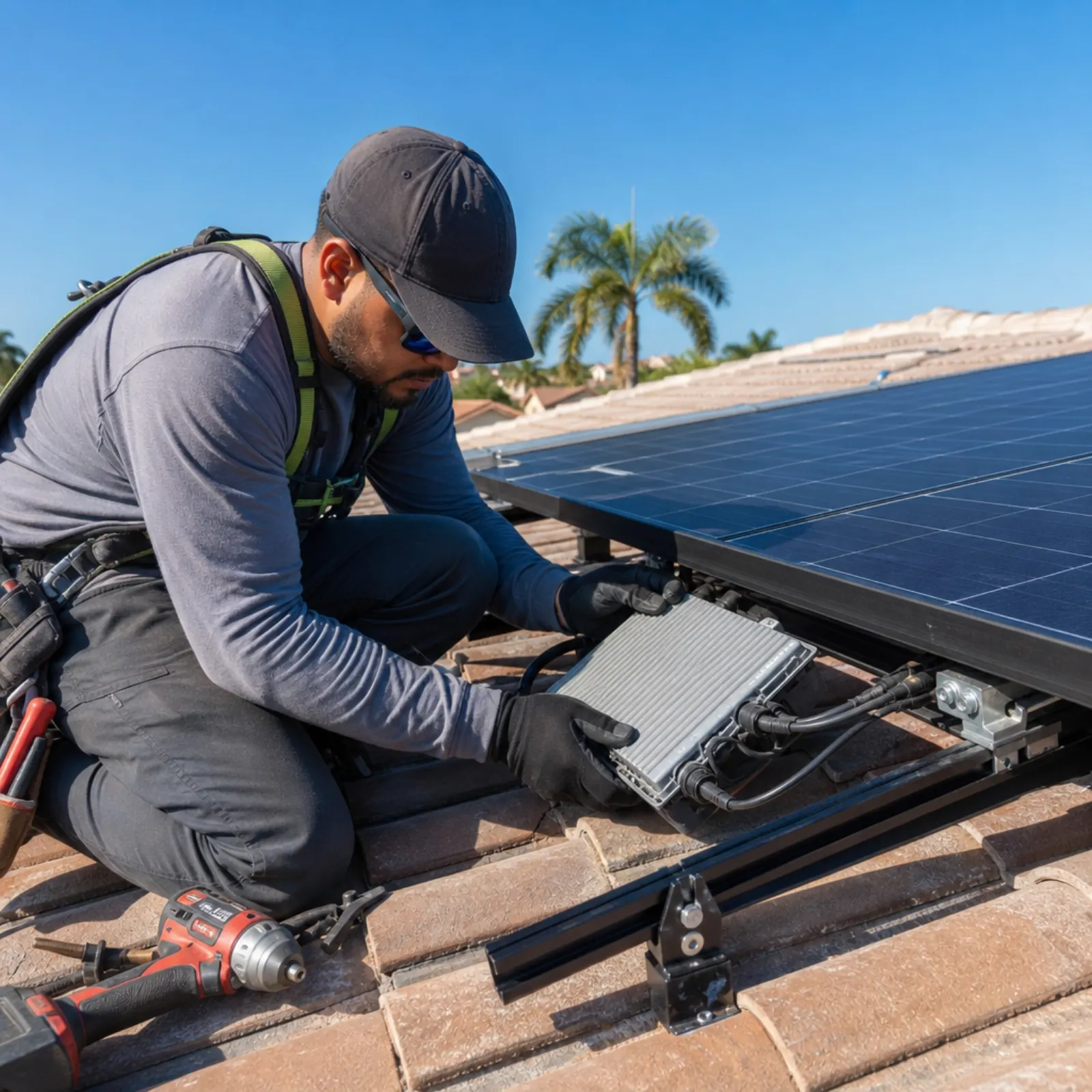
Solar inverter replacement in Cape Coral runs $1,500 to $3,500 installed for a residential string inverter in the 5 to 10 kW class, plus $200 to $500 for the permit and the FPL or LCEC interconnection update, and $300 to $600 per unit for a failed Enphase microinverter or SolarEdge optimizer. The job is confirming the fault from your monitoring data, matching or upgrading the unit, permitting it, and putting the interconnection paperwork back in order so your net-metering credit does not lapse. Send a photo of the inverter label and a screenshot of the app, and you get a diagnosis and a number.
Why inverters are failing across Lee County now
Age. String inverters last 10 to 15 years. The first meaningful wave of residential solar in Cape Coral and Fort Myers went in through the mid-2010s, and those SMA Sunny Boys, early SolarEdge units, Fronius IGs, and ABB (now FIMER) inverters are aging out on schedule. A garage wall in the Cape in August is not a kind place for power electronics.
Heat and salt. Inverters mounted on a west-facing exterior wall or in an unventilated garage run hot every afternoon for eight months a year. Near the canals, salt air corrodes terminals and fan bearings. Both shorten life.
Storms. Ian’s surge on September 28, 2022 reached 6 to 9 feet above ground in Cape Coral and along the mouth of the Caloosahatchee by the National Hurricane Center’s report, and 5 to 8 feet up the river in Fort Myers. An inverter mounted at garage height in the southeast Cape, where homes built largely before 1993 sat in standing water for days, was under water. Some ran for a year afterward and then failed. Milton’s power outages on October 9, 2024, 129,000 LCEC and 111,000 FPL customers in Lee County at the county’s next-day briefing, and the surge and sag as power came back, finished off others.
Design. Enphase M215 and M250 microinverters and early IQ6 and IQ7 units, and SolarEdge optimizers, sit under the panels in the hottest place on the house. They fail individually, and an array installed in 2016 with 24 microinverters will lose one or two every few years from here on.
Reading the symptom
- Zero production, red or amber light, error code, or blank display. String inverter fault. Some codes are ground faults or arc faults in the array wiring rather than the inverter itself, which is why the code matters before anyone quotes a new unit.
- One panel dark in the app, the rest fine. One microinverter or optimizer. Note which position; it goes on the work order.
- Several panels dark on the same roof face. Often a branch circuit or trunk cable issue rather than several failed units, or a shading and soiling problem. A production inspection sorts it out.
- The app shows nothing, or stopped updating months ago. Monitoring gateway or network. See battery and monitoring repair. Plenty of “dead inverter” calls are a $300 gateway.
- A utility bill that jumped with no app at all. Common on orphaned systems where the installer’s monitoring account died with the company. Diagnostic first.
The replacement paths
Like-for-like. The same or the current-generation model from the same maker, same mounting footprint, same DC and AC connections. Fastest and cheapest, bottom of the range. Standard for SolarEdge, SMA, and Fronius units under about 8 years old.
Upgraded string inverter. A current unit with rapid-shutdown and monitoring built in, replacing an older inverter that had neither. Common when the original brand has no direct successor. The rapid-shutdown transmitter and any conduit rework push toward the top of the range.
Retrofit to a modern architecture. A 15-year-old string inverter replaced with a SolarEdge inverter plus optimizers, or with Enphase IQ8 microinverters, which means a roof visit to add the per-panel electronics. More expensive than a like-for-like swap, but it restores per-panel monitoring, makes future single-unit failures cheap to find, and puts the array on a 25-year component warranty. Get it quoted alongside the plain swap so the choice is yours with numbers on both.
Microinverter and optimizer swaps. Lift the panel, swap the unit, reconnect, re-provision it in the gateway, verify production. Roof access and permit drive the price. One unit on a single-story shingle roof is the bottom of the range; one under a two-story tile roof in a gated community is the top. Doing three at once is cheaper per unit than three visits. On older Enphase M-series arrays, the replacement path depends on what Enphase still supplies and on the trunk cabling, and a good contractor says so before quoting.
Permits and the utility paperwork
This is the part a handyman skips and a licensed contractor does not.
Permit. Lee County’s Solar-Photovoltaic guide states that a permit is required to add or modify any photovoltaic power system, submitted through eConnect, which contractors are required to use, and inspected under the Florida Building Code 8th Edition (2023) and the 2020 NEC with a 305 Electrical Final. The City of Cape Coral permits electrical work inside city limits through its EnerGov Citizen Self Service portal. Fort Myers, Bonita Springs, Estero, and Punta Gorda each run their own. A same-model swap is a small permit. A retrofit is a bigger one with drawings.
Interconnection. Your net-metering agreement with FPL or LCEC is written under Florida Public Service Commission Rule 25-6.065 and names the inverter. FPL’s Tier 1 interconnection agreement (systems up to 10 kW) requires a UL 1741-listed utility-interactive inverter, requires the customer to provide the local building official’s inspection and certification that the installation was permitted and approved, and in Section 7 requires the customer to notify FPL by submitting a new application and interconnection agreement at least 30 calendar days before any modification that increases the system’s Gross Power Rating, with a new application and agreement in every modification case it lists. LCEC’s standard interconnection agreement likewise requires the building official’s certificate, reserves LCEC’s right to inspect the utility-interactive inverter for code compliance, and requires 10 days’ notice before equipment is placed in service. Rated output under both is DC nameplate times 0.85, so a bigger inverter that does not change the panels may not change the tier, but a different model or a size change still gets a fresh application. The contractor files it, and the new unit should not be energized until it is approved.
Rapid shutdown and labeling. An inverter change on a system installed before the NEC’s rapid-shutdown requirements usually brings the array up to current labeling and shutdown rules under the same permit. That is not an upsell; the inspector will look for it.
What it costs
| Scope | Range |
|---|---|
| String inverter, 5 to 10 kW, installed | $1,500 to $3,500 |
| Permit and interconnection paperwork | $200 to $500 |
| Microinverter or optimizer, each | $300 to $600 |
| Retrofit to optimizers or microinverters | Quoted per system |
| Diagnostic visit (usually applied to the repair) | $150 to $350 |
A like-for-like 6 kW swap on an accessible garage wall in the Cape is the bottom. A 10 kW unit on a two-story house in Estero with a new disconnect, rapid-shutdown transmitter, conduit rework, and a 30-day FPL application is the top. If the manufacturer supplies the unit under warranty, you pay labor and permit only, and the pricing page shows how that changes the math.
Warranty, honestly
The manufacturer’s warranty belongs to the unit. SolarEdge publishes 12 years on inverters and 25 on optimizers; Enphase publishes 25 years on its microinverters; SMA publishes 10 years on string inverters and, unusually, covers labor and shipping. Enphase’s current U.S. warranty, effective January 30, 2025, ships the replacement to the original installation address, requires claims within 90 days of discovering the defect, and excludes the cost of labor to uninstall the failed unit or install the new one. If the installer that registered your system is gone (SunPower, Titan Solar Power, Pink Energy, Vision Solar, ADT Solar, or a local dealer), the warranty still stands, but somebody has to file it and somebody has to climb the ladder. That is the orphaned system service.
Related
If the roof is coming off soon, replacing the inverter during the detach and reset saves a second permit and a second visit. If the array is producing but the number looks low, a cleaning and inspection with a production report is the cheaper first step.
Inverter replacement covers Cape Coral and out to Fort Myers, North Fort Myers, Lehigh Acres, Bonita Springs, Estero, and Punta Gorda. Send the inverter label and the app screenshot and get a straight answer on what failed and what it costs.
Frequently Asked Questions
How much does a solar inverter replacement cost in Cape Coral?
A residential string inverter in the 5 to 10 kW class runs $1,500 to $3,500 installed, plus $200 to $500 for the permit and the utility interconnection update. A single Enphase microinverter or SolarEdge optimizer runs $300 to $600 installed, cheaper per unit when several are done in one roof visit. If the manufacturer supplies the part under warranty, you pay labor only.
How do I know it is the inverter and not something else?
Zero production with a fault light, error code, or blank display on the inverter is the inverter. One panel dark in the app with the rest producing is one microinverter or optimizer. The app showing nothing at all is often the monitoring gateway or your Wi-Fi, not the system. Send a screenshot and a photo of the inverter; that usually settles which one it is before anyone drives out.
Can my old inverter be replaced with the same model?
Sometimes. A unit under about 8 years old from SMA, SolarEdge, Fronius, or Enphase usually has a current equivalent. A 12- to 15-year-old inverter from a brand that left the U.S. residential market, or an original Enphase M-series, often does not, and the honest answer is a retrofit to a current architecture. Ask for both paths to be quoted when both exist.
Do I need a permit and do I have to tell the utility?
Yes on both. Lee County requires a Solar-Photovoltaic permit to modify any photovoltaic system, and the City of Cape Coral permits its own electrical work. FPL's Tier 1 interconnection agreement requires a new application and agreement at least 30 calendar days before any modification that raises the system's rated output, and both FPL and LCEC require the building official's inspection certificate. A like-for-like swap is documented; a different model or larger unit gets a fresh application.
Is a failed inverter covered by warranty if my installer is gone?
The manufacturer's warranty is tied to the unit, not the installer. SolarEdge inverters carry 12 years and its optimizers 25; Enphase microinverters carry 25; SMA string inverters carry 10. Most makers ship a replacement and exclude labor, so you pay for the roof or wall work at published rates. The serial number gets checked and the claim filed before quoting.
More solar services
Areas we serve
- Cape Coral, FL
- Rooftop Solar Repair, Inverter Service, and Monitoring in Babcock Ranch
- Solar Panel Removal, Inverter Replacement, and Repair in Alva
- Solar Panel Removal, Inverter Replacement, and Repair in Bonita Springs
- Solar Panel Removal, Inverter Replacement, and Repair in Estero
- Solar Panel Removal, Inverter Replacement, and Repair in Fort Myers
- Solar Panel Removal, Inverter Replacement, and Repair in Lehigh Acres
- Solar Panel Removal, Inverter Replacement, and Repair in North Fort Myers
- Solar Panel Removal, Inverter Replacement, and Repair in Port Charlotte
- Solar Panel Removal, Inverter Replacement, and Repair in Punta Gorda
- Solar Panel Removal, Inverter Replacement, and Repair on Fort Myers Beach
- Solar Panel Removal, Inverter Replacement, and Repair on Pine Island