 Cape Coral Solar Service
 Solar Panel Removal and Reinstall for Re-Roofs in Cape Coral
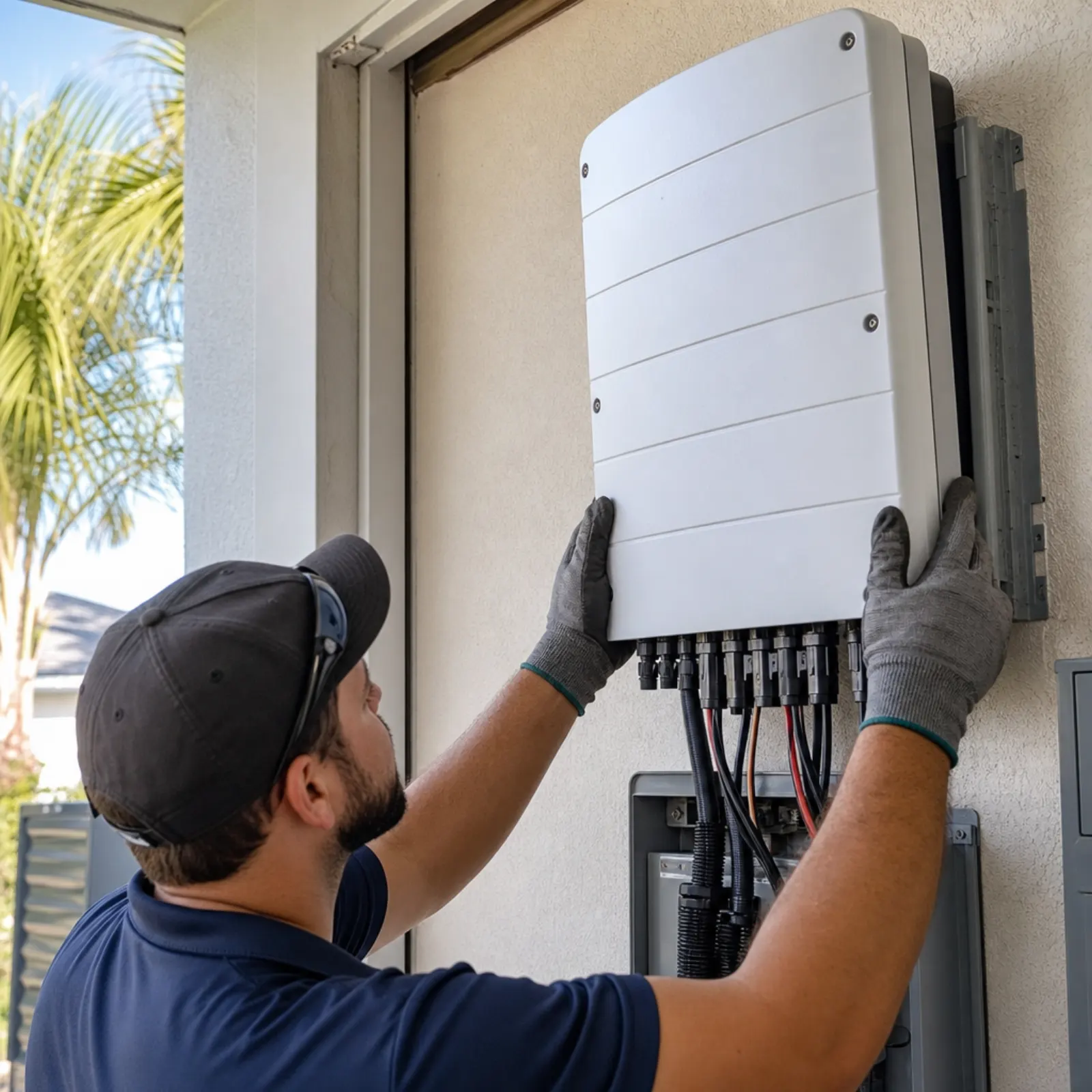
Solar panel removal and reinstall for a re-roof in Cape Coral runs $200 to $400 per panel, so a 20-panel array is $4,000 to $8,000 including detach, on-site storage, reset on the new roof, and re-commissioning, with new flashed attachments usually extra at $25 to $60 each. The roofer will not touch the panels, the original installer is often gone, and the job has to be permitted and inspected in Lee County. Send a photo of the array and the roofer’s tear-off date and you get a number and a schedule.
Why this is the busiest solar job in Lee County
Southwest Florida is replacing roofs faster than anywhere in the country, and a large share of them have solar on them.
Hurricane Ian, September 28, 2022. The National Hurricane Center’s final report puts Ian’s landfall at Cayo Costa with 130-knot winds, a second landfall near Punta Gorda at 125 knots, and 6 to 9 feet of surge inundation in Pine Island, Cape Coral, and the communities at the mouth of the Caloosahatchee. In Lee County, 52,514 structures were impacted, 5,369 destroyed and 14,245 with major damage. Ian’s Florida damage came to $109.5 billion, the costliest hurricane in state history. Thousands of tile and shingle roofs that survived did so with lifted tiles, cracked underlayment, and stressed fasteners, and many are being replaced now rather than repaired.
Hurricane Milton, October 9, 2024. The National Weather Service Tampa Bay final survey documents an EF2 tornado with 132 mph winds that started south of Gladiolus Drive in Fort Myers, tore a large portion of a roof off a home along Orangewood Avenue near Colonial Boulevard, crossed the Fort Myers Country Club and the Caloosahatchee, and damaged manufactured-home communities in North Fort Myers before lifting near US 41. A separate EF1 in Matlacha ripped half the roof off two homes. Lee County reported 129,000 LCEC and 111,000 FPL customers without power at its October 10 briefing.
The insurance clock. Florida Statute 627.7011(5), added in the May 2022 special session, says an insurer may not refuse to issue or renew a policy solely because of roof age if the roof is under 15 years old, and for a roof 15 years or older must allow an inspection at the homeowner’s expense; if the inspection shows five or more years of useful life, age alone cannot be the reason for refusal. In practice, a 15-year-old shingle roof in the southeast Cape that cannot pass that inspection is getting replaced at renewal time, and the array on it is coming off.
The roof stock. Cape Coral’s southeast quadrant carries original 1960s and 1970s concrete-block bungalows and 1980s and 1990s tract homes, largely built before 1993. The southwest has older canal-front block homes next to new luxury builds. Tile, shingle, and metal all show up, and each one is a different reset job.
Who is allowed to do it
Florida Statute 489.105(3) defines a solar contractor as one whose services consist of the installation, alteration, repair, maintenance, relocation, or replacement of photovoltaic systems and their equipment. Electrical contractors carry the same scope. The roofing contractor definition in the same statute covers roofing, waterproofing, and roof-deck attachments; it does not cover the array. That is why a Lee County solar installer’s own published guidance says roofers are not authorized to remove, reinstall, or handle solar panels or their electrical components, and that the reinstall permit can only be pulled by a licensed solar (CVC) or electrical (EC) contractor.
Before a crew touches the array, confirm its CVC or EC license on the state’s licensee search and ask for proof of insurance. Attachments and flashing are the one place the roofer’s license overlaps, and that overlap is handled in writing.
How a detach and reset actually goes
- Plan review from photos. Panel count and layout, racking brand (IronRidge, Unirac, SnapNrack), attachment type (lag-and-flashing, tile hooks, standing-seam clamps), inverter type (string, SolarEdge optimizers, Enphase microinverters), monitoring access, and roof material. This is enough to quote and to start the permit drawings.
- Coordinate with the roofer. The solar crew needs the tear-off date, the dry-in date, and a written answer on who sets the attachments. Detach is scheduled 1 to 3 days before tear-off.
- Detach. Disconnects and rapid shutdown locked out. Every string labeled at both ends. Microinverters or optimizers left on the panels and labeled by position. Panels stacked on pallets on site, covered. Rails and hardware bagged and labeled. Conduit capped at the roof. Roof deck photographed at every attachment point for the record.
- Roofing. The roofer strips, re-decks where needed, dries in, and installs the new roof. If the roofer is setting the solar flashings, they go in during this stage on the layout the solar crew provides.
- Reset. New flashed attachments if the solar crew is setting them, then rails, panels in the original positions, wiring restored by the labels, rapid shutdown verified, grounding and bonding checked, labels replaced.
- Re-commission. Inverter startup, per-panel or per-string production verified in monitoring, ground-fault and insulation checks, and a production reading against expected output for the day.
- Close out. Final inspections requested (Lee County closes a roof-mounted system with a 207 Solar Final and a 305 Electrical Final; the City of Cape Coral has its own equivalents), and the utility notified if anything about the interconnection changed.
Permits: Cape Coral versus Lee County versus everyone else
Where the house sits decides who issues the permit.
- City of Cape Coral. The Building Division at City Hall, 1015 Cultural Park Boulevard, permits roofing, electrical, and solar work through the EnerGov Citizen Self Service portal.
- Unincorporated Lee County (most of North Fort Myers and Lehigh Acres, plus county pockets everywhere). Building and Permitting Services at 1500 Monroe Street, Fort Myers, via eConnect, which contractors are required to use. The county’s Solar-Photovoltaic guide requires a site plan, an electrical diagram, signed and sealed wind-load documentation from a Florida-registered design professional showing the uplift zone and pressure for the roof area, weight documentation under 5 pounds per square foot and 45 pounds per attachment, and construction drawings, under the Florida Building Code 8th Edition (2023) and the 2020 NEC. An issued permit must pass an inspection within 180 days or it expires.
- Fort Myers, Bonita Springs, Estero, Punta Gorda. Each city or village issues its own permits inside its limits; Charlotte County’s Community Development handles unincorporated Charlotte and requires signed and sealed electrical and structural engineering or FSEC certification plus a roof structure affidavit.
Wind load is the whole reason the reinstall is engineered. Lee County is not in the Miami-Dade and Broward high-velocity hurricane zone, but the Florida Building Code’s design wind speeds for this coast are among the highest in the state, and the attachments are what hold the array to the roof when the next Ian arrives. A crew that resets panels on the old lag pattern without a permit is guessing with your roof.
Tile, shingle, metal: three different resets
- Concrete or clay tile. The most common re-roof in the Cape’s waterfront neighborhoods and in Bonita Springs and Estero HOAs. Attachments go to the deck under the tile with flashed tile hooks or replacement flashing tiles; surrounding tiles are cut and re-set. Slower and more careful, hence the top of the price range. Tile-to-tile resets also need the roofer to leave the field tiles off around each attachment point until the solar crew is done, or to set the hooks themselves.
- Asphalt shingle. The fastest reset. Lag-and-flashing attachments into rafters or trusses, flashing under the course above. Most of the southeast and northeast Cape.
- Standing-seam metal. Clamp attachments to the seams, no penetrations, no flashing. Often the cheapest reset and a reason some owners choose metal when the roof comes off.
- Metal over tile, or a material change. A material change usually changes the attachment type and therefore the wind-load calculation, so it goes on the permit drawings as a modification.
What to put in the roofing contract
Before you sign with the roofer, get these lines in writing: the tear-off and dry-in dates; that the solar crew detaches before tear-off and resets after dry-in; who sets the solar flashings and who warrants the roof at those points; that the roofer will not cut, move, or cover conduit and junction boxes without calling; and that the roof warranty is not voided by the reinstall. The solar contractor should give the roofer the attachment layout and the flashing specification. Most Lee County roofers have done this dance many times since Ian; the ones who have not will appreciate the paperwork.
What it costs
| Scope | Range |
|---|---|
| Detach and reset | $200 to $400 per panel |
| 20-panel system | $4,000 to $8,000 |
| New flashed attachments | $25 to $60 each |
| Permit and interconnection paperwork | $200 to $500 |
| Off-site storage (if the job stalls) | Quoted |
Shingle, single-story, clean racking, 20 panels: bottom of the range. Tile, two-story, corroded hardware near a saltwater canal, 30 panels: top. The pricing page has the full table, and the detach and reset calculator builds a range from your panel count and roof type before you call. If the inverter is also at end of life, doing the inverter replacement during the reset saves a second permit and a second visit, and it is worth asking about.
Related
An array that has been off the roof is the best moment for a production inspection: every panel is on the ground, every connector is visible, and cracked glass or corroded MC4s get caught before they go back up. If your installer is one of the companies that closed, the reset also doubles as an orphaned-system takeover, with the system documented and monitoring restored under your own account.
Detach and reset is available across Cape Coral and out to Fort Myers, North Fort Myers, Lehigh Acres, Bonita Springs, Estero, and Punta Gorda. Send the array photo and the roofer’s date, and we can get you a number and a plan that keeps your roof from waiting.
Frequently Asked Questions
What does it cost to remove and reinstall solar panels for a new roof?
Detach and reset runs $200 to $400 per panel, so a 20-panel system is $4,000 to $8,000 including labor, on-site storage, and re-commissioning. New flashed roof attachments are usually extra at $25 to $60 each, and permit and interconnection paperwork adds $200 to $500. Tile roofs sit at the top of the range, shingle at the bottom, standing-seam metal with clamps often below it.
When should the panels come off relative to the roofing job?
One to three days before tear-off. That gives the crew time to label strings, cap conduit, lock out the disconnects, and stack panels safely on site, and it keeps the roofer from arriving to a roof they cannot strip. Reset happens after the roof is dried in and the roofer has cleared the deck, usually the day after the roofing final.
Who installs the new roof attachments, the roofer or the solar crew?
Either, and it must be in writing before tear-off. The attachments are flashed penetrations, so whoever sets them warrants the roof against leaks at those points. Many Lee County roofers prefer to set solar flashings during the roof so their warranty is clean; others want the solar crew to do it under the solar permit. Put the choice in the scope so nobody points at the other trade later.
Is the reinstall permitted?
Yes. Lee County's Solar-Photovoltaic permit guide requires a permit to add or modify any photovoltaic system and calls for signed and sealed wind-load documentation showing the uplift zone and pressure for the roof area where the panels sit. The City of Cape Coral permits its own roofing, electrical, and solar work through the EnerGov portal. The reinstall permit is separate from the roofer's re-roof permit and is closed with solar and electrical finals.
Will my panels go back in the same spot?
Usually. The new roof rarely changes the array layout, and keeping the layout avoids a new wind-load calculation and an interconnection change. The exceptions are a roof that changes material (tile to metal, for example), a roof section the roofer rebuilt, or an owner who wants the array moved. Any layout change goes on the permit drawings.
More solar services
Areas we serve
- Cape Coral, FL
- Rooftop Solar Repair, Inverter Service, and Monitoring in Babcock Ranch
- Solar Panel Removal, Inverter Replacement, and Repair in Alva
- Solar Panel Removal, Inverter Replacement, and Repair in Bonita Springs
- Solar Panel Removal, Inverter Replacement, and Repair in Estero
- Solar Panel Removal, Inverter Replacement, and Repair in Fort Myers
- Solar Panel Removal, Inverter Replacement, and Repair in Lehigh Acres
- Solar Panel Removal, Inverter Replacement, and Repair in North Fort Myers
- Solar Panel Removal, Inverter Replacement, and Repair in Port Charlotte
- Solar Panel Removal, Inverter Replacement, and Repair in Punta Gorda
- Solar Panel Removal, Inverter Replacement, and Repair on Fort Myers Beach
- Solar Panel Removal, Inverter Replacement, and Repair on Pine Island